
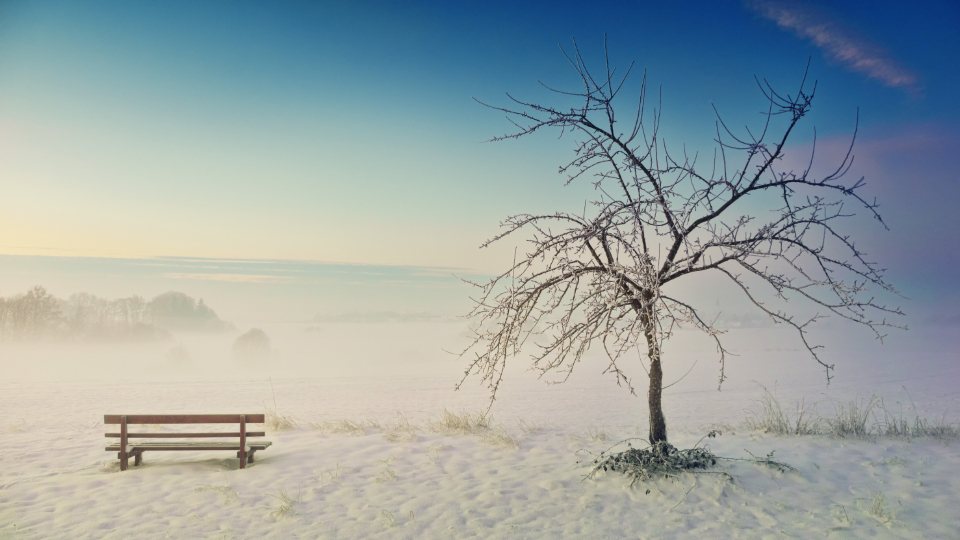
There is a kind of outdoor time that involves no walking, no equipment and no achievement. It is sitting on a bench with nothing to do, and we think it is undervalued. In a culture that measures time outside in kilometres and summits, the person on the bench looks like someone who has given up. In fact they are doing something the rest of us have mostly forgotten how to do.
This article is a defence of sitting still outside, and a short guide to doing it well. It is aimed at people who find it hard, which in our experience is nearly everyone under seventy.
Why sitting still counts
The evidence that time in green places is good for us has been building for decades, and very little of it depends on effort. Psychologists studying what they call attention restoration since the 1980s have found that natural scenes let the mind rest in a way that streets and screens do not, because they hold attention softly rather than demanding it. The Japanese practice of forest bathing, promoted by the country’s forestry agency from 1982, is essentially slow, unhurried time among trees, and has been studied for its effects on stress hormones and blood pressure.
A large study published in 2019, based on roughly twenty thousand people in England, found that those who spent at least two hours a week in natural settings were more likely to report good health and wellbeing, and that it did not seem to matter whether the two hours came in one visit or several short ones. Sitting counted as much as walking. Two hours a week is twenty minutes a day on a bench, which most of us could manage.
The bench as a place
Public benches are one of the great unsung facilities of any town. They are free, they are everywhere, and they turn a view into a room. The best ones are chosen with care: facing the afternoon sun in winter, in shade in summer, with something moving in front of them, such as water, a path or a busy tree. Many carry a plaque for someone who loved the spot, which is a fair recommendation.
We suggest keeping a private list of good benches within reach of home. One for the early morning, one for the last light, one for wind and one for rain, ideally under a tree or a shelter. Once you have the list, the decision to go and sit takes no thought, and thoughtless decisions are the ones that happen.
For anyone who cannot easily walk far, a bench is not the reward at the end of the outing. It is the outing, and choosing a bench with a firm path, a back and armrests is the difference between going and not going.
The outdoor table
A cafe table on a pavement or a terrace is the bench’s more sociable cousin. It costs the price of a drink, comes with a chair that has a back, and gives you permission to stay for an hour without anyone wondering why. In many countries the outdoor table is where a lot of ordinary public life happens, and it is one of the easiest ways to be outside for someone who feels awkward simply sitting on a wall.
The trick is to face outwards. Sit with your back to the building and your face to the street, the square or the harbour. Order something hot in winter and something long in summer, put the phone face down, and let the place come to you. Watching a street for an hour is a form of nature study; the pigeons, the gulls, the sparrows under the tables and the dog that visits each chair in turn all have their routines.
How to actually do nothing
Doing nothing is a skill and it has a learning curve. The first five minutes are the worst. The mind hunts for a task, the hand reaches for a pocket, and the body wants to stand up. What follows has helped us:
- Set a modest time, twenty minutes, and decide in advance not to leave earlier.
- Choose one sense to pay attention to for a few minutes, then another: sounds, then smells, then the movement of leaves.
- Count something slowly. Birds passing, people with hats, gusts of wind.
- Bring a hot drink. Holding a cup gives the hands a job and the sitting a shape.
- Let boredom happen. It usually passes in about ten minutes and leaves something quieter behind.
A notebook is allowed, on the understanding that it is for noticing, not for planning. So is a book, though we have found that a book read outside tends to be closed after a page or two, which is fine.
Weather and seasons
Sitting is colder than walking, because the body is not producing heat and the ground and bench are drawing it away. A folded jacket or a small foam pad under you makes a bigger difference than an extra layer on top. In winter, a bench in full sun out of the wind can be pleasant at air temperatures close to freezing; the same bench in shade will send you home in ten minutes.
Rain is not the end of sitting outside. Shelters, bandstands, lychgates, bus shelters and the deep porches of old buildings all offer a dry seat with a view. Some of our best hours of doing nothing have been spent watching rain move across a park from under a roof.
Summer evenings are the easy season. The air is warm long after the sun has gone, swifts and then bats take over the sky, and nobody looks twice at someone sitting on a bench at nine o’clock.
What it gives back
We cannot promise much. Sitting still outside will not get you fit or take you anywhere. What it does is change the scale of your attention. After a season of regular benches you will know when the blackbirds stop singing in the evening and when they start again in February, which corner of the square holds the first warmth of the year, and how long a heron stands before it moves.
Those are small things, but they are the small things that make a place yours, and they are available to anyone who can get to a seat. The walkers and the swimmers are welcome to their kilometres. The bench is enough.