
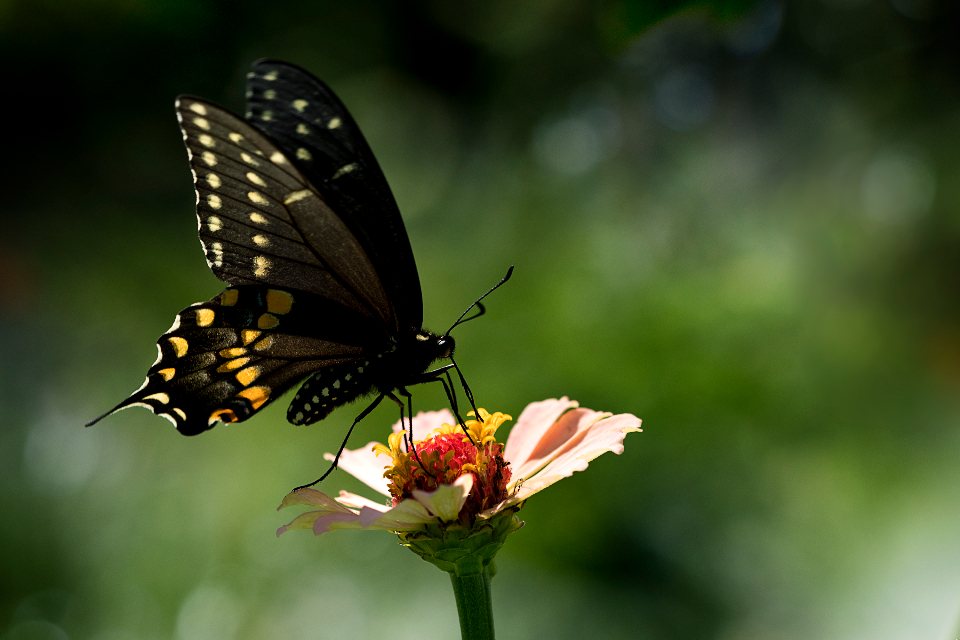
A garden, a yard, a balcony with a few pots or a strip of council verge is enough. Butterflies and moths do not need wilderness; they need nectar, a plant to lay eggs on and somewhere to shelter, and they will find those things wherever they exist. For us, the watching asks for nothing but patience and a warm hour. In the course of a summer, a modest garden in a temperate climate can host a dozen kinds of butterfly by day and several dozen moths by night, most of them passing through unnoticed unless we go looking.
Telling the two apart
Butterflies and moths belong to the same order of insects, and the line between them is more habit than rule. Butterflies usually fly by day, hold their wings closed upright when at rest and have thin antennae ending in a small club. Most moths fly at night, rest with their wings flat or folded like a roof, and have antennae that taper to a point or spread into feathers, especially in males. There are exceptions on both sides. The hummingbird hawk-moth hovers at flowers in bright sunshine, and a few day-flying moths are as brightly coloured as any butterfly. Where we live, moth species outnumber butterfly species by roughly forty to one, so the night shift is by far the larger part of the story.
When to look by day
Butterflies are cold-blooded and cannot fly until their flight muscles are warm. Below about 13 degrees Celsius they stay put; in dull weather they sit with their wings open to catch what sun there is. The best watching is between mid-morning and mid-afternoon on a still, bright day, when the air is above 17 degrees and the wind is light. A cloud crossing the sun empties a flower bed in seconds and refills it a minute later. Early spring brings the species that overwinter as adults, often on the first warm afternoon in March: the brimstone, lemon-yellow and leaf-shaped; the peacock with four eye spots; the small tortoiseshell; the ragged-edged comma. High summer is the peak, with whites, browns and blues on the wing together, and a warm September can be almost as busy as July as the year’s second broods emerge.
We watch flowers rather than the air. A patch of flowering marjoram, lavender, scabious, knapweed or ivy in autumn will be visited over and over, and a butterfly feeding is a butterfly that stays still long enough to be looked at. Soft ground and puddle edges attract some species to drink minerals; overripe fruit left on a plate brings the red admiral and the comma in late summer.
Growing for caterpillars, not just for adults
Nectar draws butterflies in, but only the right food plant keeps them. Each species lays its eggs on a small number of plants, and a garden without those plants is a restaurant rather than a home. A few reliable pairings:
- Common nettle in a sunny corner feeds the caterpillars of the peacock, small tortoiseshell, comma and red admiral.
- Holly in spring and ivy in late summer feed the two generations of the holly blue.
- Garlic mustard and lady’s smock feed the orange-tip.
- Long, uncut grasses feed the meadow brown, gatekeeper, ringlet and speckled wood.
- Bird’s-foot trefoil feeds the common blue; buckthorn feeds the brimstone.
- Willowherb and bedstraw feed the elephant hawk-moth; grasses and low plants feed the yellow underwings.
Leaving a square metre of nettles and a strip of grass uncut until September costs nothing and does more for the garden’s insects than any amount of planting. A tidy garden in October is one that has thrown its next generation away with the trimmings.
Looking after dark
Moth watching sounds specialist and is not. The simplest method is a white sheet hung over a washing line or laid on the ground with a bright torch or a lamp set beside it on a mild, still, cloudy night. Moths land on the sheet and can be looked at, photographed and left alone. A lit window with the curtains open does the same in miniature. Warm nights from June to August are the richest, but there are moths in every month; some species fly only in December and January. Flowering plants that release scent in the evening, such as honeysuckle, evening primrose and night-scented stock, are worth standing beside at dusk with a torch angled low.
The rewards are surprising. The elephant hawk-moth is pink and olive green and the size of a thumb. The large yellow underwing flashes orange when it flies. Tiger moths are patterned like an old carpet, and the silver Y, a migrant that arrives from the south in numbers, wears a neat metallic letter on each forewing. Many moths that look brown at a glance turn out, in a torch beam, to be marbled in grey, cream and rust.
Watching gently and keeping notes
None of this needs a net. Butterflies at flowers can be approached to within arm’s length if we move slowly and keep our shadow off them. Moths on a sheet can be coaxed onto a finger or a leaf and released into cover at dawn, before the birds find them. A photograph of the upper and lower wing surfaces is usually enough to put a name to a butterfly later, and for moths a picture of the resting insect from above tells most of the story. We keep a note of the date, the temperature and what was flowering; over a few years the notebook becomes a private record of how the seasons are shifting.
For anyone who cannot get down to the flower bed, the garden can be arranged to come up to them. A raised bed or a large pot of lavender at chair height beside a door, a sunny wall with a bench, or a window box of marjoram on a balcony will be found by butterflies within a summer. The best places to watch are the ones where we can sit still for twenty minutes, and a butterfly on a flower at eye level is one of the easiest and kindest pieces of nature watching there is.