
Stargazing is one of the few outdoor pursuits that asks for no equipment, no fitness and no travel. A back step, a garden bench or a bit of park with the streetlight behind a tree will do. What it does ask for is patience. Our eyes take twenty to thirty minutes to adapt fully to the dark, and every glance at a phone screen sets the clock back. So we go out, we sit, we let the sky come to us, and then we start to find things. Here are ten that anyone in the northern hemisphere can find without so much as a pair of binoculars.
The ten, in one list
- The Plough, the seven-star saucepan that is the easiest signpost in the sky.
- Polaris, the North Star, found by following the two stars at the end of the Plough’s bowl.
- Cassiopeia, the wide W on the opposite side of Polaris from the Plough.
- Orion, the winter hunter with three stars in a neat row for a belt.
- Sirius, the brightest star in the whole night sky, below and left of Orion.
- The Pleiades, a tight, misty cluster of stars that looks like a tiny saucepan itself.
- The Summer Triangle, three bright stars high overhead on warm evenings.
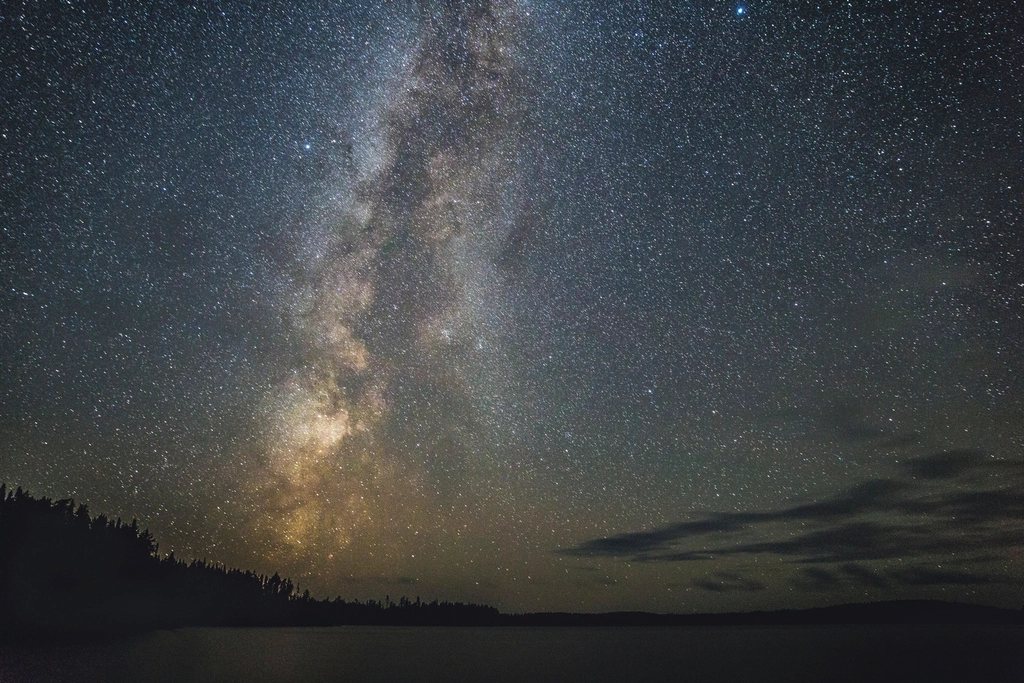
- The Milky Way, the pale band of our own galaxy seen edge-on.
- The planets, which do not twinkle and wander along the same path as the Moon.
- The Andromeda Galaxy, the farthest thing a human eye can see without help.
The signposts: Plough, Polaris and Cassiopeia
Everything begins with the Plough. It is not a constellation on its own but the brightest part of the Great Bear, and from most of Europe and North America it never sets; it simply wheels around the sky through the year, high in spring, low in autumn. Once found, its two end stars point almost exactly to Polaris, about five times the distance between them. Polaris is not especially bright, which surprises people, but it is special for another reason: it sits almost directly above the Earth’s axis, so the whole sky appears to turn around it while it stays put. Face it, and we are facing north.
Continue the line from the Plough through Polaris and about the same distance again, and we reach Cassiopeia, a lazy W or M of five stars depending on the season. Plough and Cassiopeia sit on opposite sides of the pole, so when one is high the other is low, and one of them is always visible.
Winter: Orion, Sirius and the Pleiades
From November to March the southern sky belongs to Orion. The three belt stars are unmistakable, and around them stand four bright corners: a reddish star at the top left, a blue-white one at the bottom right. Hanging from the belt is a faint smudge, the sword, which is a cloud of gas where new stars are forming, some 1,300 light years away.
Follow the belt down and to the left and the line arrives at Sirius, which is so bright and so low in the sky that it often flickers through every colour of the rainbow. Follow the belt the other way, up and to the right, and it passes a bright orange star and carries on to the Pleiades, a small cluster that most people can count six or seven stars in, and some can count more. The Pleiades are about 440 light years away and are young, as stars go, at around 100 million years old. They look better slightly to one side of where we stare, a trick called averted vision that works on every faint thing in the sky.
Summer: the Triangle and the Milky Way
On a July or August evening, look straight up and find three bright stars forming a large, lopsided triangle. The brightest is Vega, blue-white and nearly overhead. Deneb is at the tail of the Swan, and Altair sits lower with a fainter star either side of it. Together they are the Summer Triangle, and they hang in the evening sky from June until the frosts.
Running right through the Triangle, if the night is dark and the Moon is down, is the Milky Way. It is not a cloud, though it looks like one. It is the combined light of hundreds of millions of stars in the disc of our galaxy, and from a properly dark place in August it is bright enough to cast a faint shadow. From a town it is invisible, which is the strongest argument there is for a night in the hills.
The wanderers: planets and passing satellites
Stars twinkle because their light is a single point disturbed by the air. Planets are tiny discs, so their light averages out and they shine steadily. That is the first test. The second is position: planets stay close to the path the Sun and Moon follow across the sky, never up by the Plough. Venus is the brightest, appearing only in the west after sunset or the east before dawn. Jupiter is next, a calm cream-coloured beacon that can be out all night. Mars is unmistakably orange, and Saturn is a quieter yellow.
There are also things that move while we watch. Satellites cross the sky in a few minutes, steady points of light with no flashing, which sets them apart from aircraft. The largest space station is brighter than any star when it passes, taking three to six minutes to cross from one horizon to the other, always in the hour or two after dusk or before dawn when it is lit by a Sun we cannot see.
The far edge: Andromeda
The tenth thing is the hardest and the most rewarding. Below Cassiopeia, on a moonless autumn night far from streetlights, lies a faint oval smudge about the width of a finger held at arm’s length. It looks like nothing. It is the Andromeda Galaxy, a spiral of perhaps a trillion stars, two and a half million light years away. The light landing on our eyes left it before our species existed. Finding it takes a dark sky, adapted eyes and averted vision, and it is worth every one of the thirty minutes we spent waiting in the cold.
Ten things is a good beginning, and none of them go anywhere. The Plough will be there tomorrow, and Orion will be back next winter. The sky is the one outdoor place that is always open and never crowded, and it starts a step outside the door.