
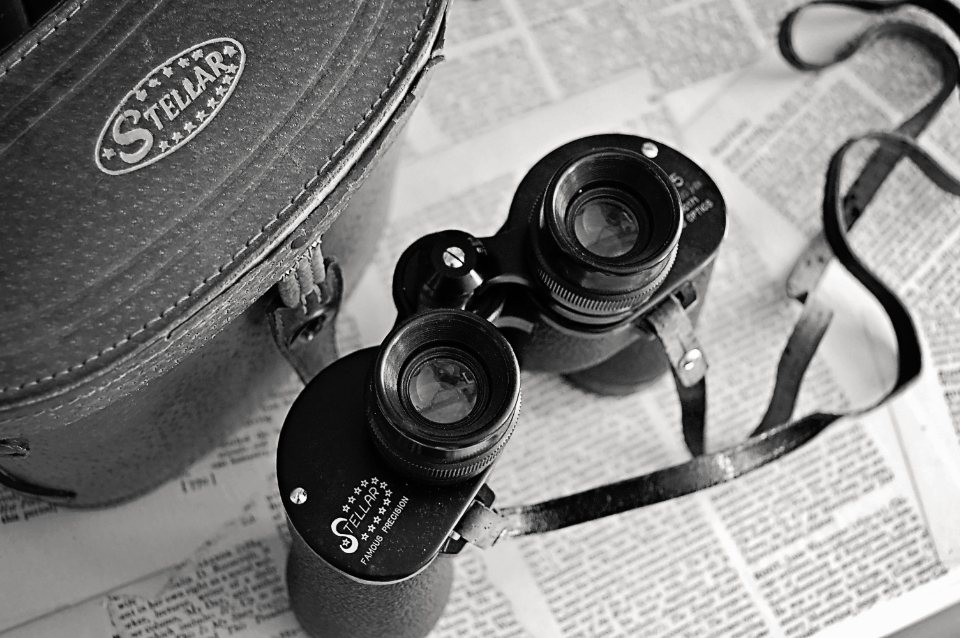
Every pair of binoculars carries a short code on the body, something like 8×42 or 10×25, and most of what we need to know is hidden in it. The rest of the decision comes down to four or five more numbers printed in the small type of a specification sheet. None of them require a brand, a review or a shop assistant. If we understand what the figures mean for our eyes, our hands and the places we walk, we can choose well from a table of specifications alone, and we can spot when a low price is buying us something we will not enjoy using.
Magnification: the first number
The first figure is the magnification. An 8x pair makes a bird 80 metres away look as if it were 10 metres away. A 10x pair brings it to 8 metres. That sounds like a clear win for the larger number, and for someone standing on a headland scanning a distant shore it can be. For most of the watching we do, from gardens, hedges and woodland paths, 8x is the gentler choice. The image shakes less in our hands, the view is wider, and we find the bird faster once we raise the glass. Above 10x, hand-held binoculars become hard to hold steady without a support, whatever the price.
A fair test is to hold an imaginary pair to our eyes for thirty seconds. If our arms tire or tremble, and for many of us they do, the lower magnification will show us more, not less, because a steady image reveals detail that a wobbling one hides.
Objective diameter: the second number
The second figure is the diameter, in millimetres, of the large front lenses. It governs how much light the binoculars gather and how much they weigh. A 42 millimetre pair collects around 70 percent more light than a 32 millimetre pair and roughly three times as much as a 25 millimetre pair. That matters at dawn and dusk, under a tree canopy and in winter, exactly the times and places where the most interesting things happen. It also matters for the shoulders: a typical 8×42 weighs between 600 and 850 grams, an 8×32 between 400 and 550 grams, and an 8×25 or 10×25 compact around 250 to 350 grams.
The trade-off is honest. Bigger glass shows more and costs more to carry. Someone who walks for hours or uses a stick may be happier with 32 millimetres; someone watching from a window or a bench can enjoy 42 millimetres without paying the weight penalty at all.
Exit pupil and the age of our eyes
Divide the second number by the first and we get the exit pupil, the diameter of the little disc of light that leaves each eyepiece. An 8×42 gives 5.25 millimetres; a 10×42 gives 4.2; an 8×32 gives 4; a 10×25 gives just 2.5. Our own pupils open to around 7 millimetres in the dark when we are young and to perhaps 4 or 5 millimetres by our fifties and sixties. When the exit pupil is smaller than our pupil, the image looks dim in low light. When it is larger, we waste a little light but gain an easy, forgiving view that does not black out when the binoculars move slightly on the face. For anyone who wants to use binoculars in the half-light of a dawn chorus or an evening bat walk, an exit pupil of 4 millimetres or more is worth having.
Field of view, close focus and eye relief
Three more figures separate a comfortable pair from a frustrating one.
- Field of view is quoted as the width, in metres, of the scene visible at 1,000 metres, or as an angle in degrees. For an 8x pair, 120 to 140 metres (roughly 7 to 8 degrees) feels generous; under 110 metres feels like looking down a tube. Wider is easier for finding a bird in a tree and for following one in flight.
- Close focus is the nearest distance at which the image is sharp. Anything under 3 metres opens up butterflies, dragonflies and flowers, which is half the joy of a garden or a pond. Some pairs focus to 1.5 metres; some cannot manage 5.
- Eye relief is the distance, in millimetres, from the eyepiece to the point where the whole image is visible. Anyone who wears glasses while watching should look for 15 millimetres or more, with eyecups that twist down. Less than that, and the edges of the view vanish behind the spectacles.
Numbers that hide in the words
A few features are described rather than measured, and they still matter. Waterproofing and nitrogen or argon filling keep the inside from fogging when we walk from a cold morning into a warm kitchen, and they are worth having in any damp climate. Fully multi-coated lenses transmit more light than coated or multi-coated ones, and the wording is precise: each step up is a real improvement. Roof-prism designs are slim and straight; porro-prism designs have the old-fashioned offset shape, are often cheaper for the same optical quality and give a slightly more three-dimensional view. Neither is wrong. Interpupillary distance, the range over which the two barrels can be moved apart, matters for children and for anyone with narrow-set eyes; a minimum of 56 millimetres or less suits most young faces.
Putting the numbers together
For a first pair used on walks from the door, in gardens and parks and at the edge of woods, we find that 8×32 or 8×42 with a close focus under 3 metres, a field of view above 120 metres and eye relief of at least 15 millimetres covers nearly everyone. For someone who mostly watches water or open country, 10×42 earns its extra reach. For a pocket on a school run or a pair left on the windowsill, an 8×25 is light and cheerful, as long as we accept that dusk will be dim.
The last number is the one we set ourselves: how much we are willing to spend. The pleasing truth is that the specification sheet does not care about the label on the strap. Two pairs with the same figures behave similarly in the hand, and the price difference between them often buys refinements at the edge of the image that most of us will never notice while a wren is shouting from the ivy. We choose by the numbers, then we go outside and forget about them.