
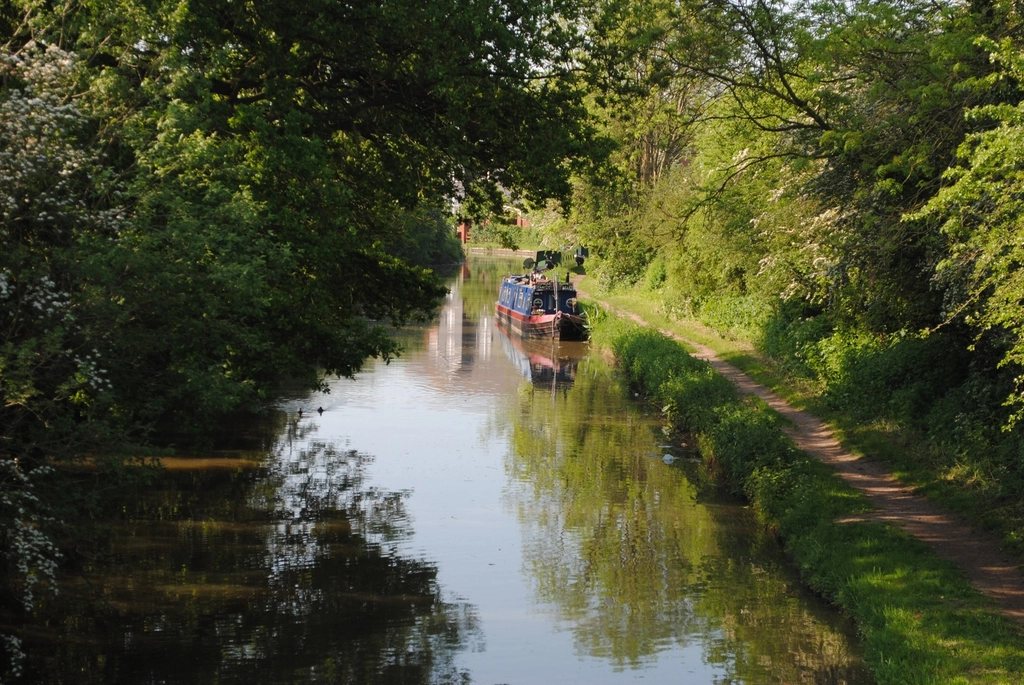
Some of the best walks we know have no summit, no view to speak of and no gradient at all. They follow water. A canal towpath or a riverside path gives us a route that is flat, obvious, impossible to lose and full of small events: a heron lifting off, a lock filling, a moorhen fussing in the reeds. Water walks suit people who cannot manage hills, children who tire quickly, prams, wheelchairs on the right surface, and anyone who simply wants to go slowly for a while. This is a guide to reading them, choosing them and enjoying them.
Why canals are so walkable
A canal is a river that has been argued into behaving. It was dug flat, in level stretches called pounds, and where the land rose or fell the engineers built locks, so a canal climbs a valley in steps rather than slopes. The path beside it, the towpath, was made for horses pulling boats, which means it was never allowed to be steep, narrow or interrupted. Most of those horses are long gone, but the path they walked remains, and it is one of the most accessible kinds of countryside there is.
Because the gradient is nearly nothing, a towpath walk is measured in time and interest rather than effort. A gentle pace covers three to four kilometres in an hour, and the boats, where there are any, go no faster than walking pace themselves. Canals in many countries have numbered bridges and mileposts, so we always know where we are, and the water itself is the map: follow it one way, turn round, follow it back.
Reading a lock
Locks are the theatre of the canal. A boat enters a chamber, gates close behind it, paddles are opened, the chamber fills or empties, and the boat rises or sinks by anything from a metre to four or five, and then the far gates swing open. The whole performance takes ten or fifteen minutes and is best watched from the lock side with a flask. Where locks come in flights, one after another up a hillside, we can spend a whole afternoon walking beside them.
There are things to know. Lock sides are often cobbled or stepped, and the balance beams that open the gates swing across the path. Small children are kept close, and wheelchairs and prams usually need a way around rather than over. The edge of a lock is deep water with no easy way out, so it is a place to watch, not to lean.
Rivers: the wilder cousin
A river path has everything a canal has and one thing more: the water is going somewhere. Rivers meander, cut into the outside of bends and drop silt on the inside, spread over floodplains in winter and shrink to gravel shoals in a dry August. The path may rise and dip where it crosses a tributary or skirts a wet meadow, and it will sometimes be muddy in ways a towpath never is.
In return we get weirs, where the river drops in a white sheet and the sound alone is worth the walk; confluences, where two rivers meet and their colours stay separate for a few hundred metres; and floodplain meadows that turn yellow with flowers in June and silver with frost in January. After heavy rain a river can rise a metre or more in hours, so a riverside walk in a wet week is one we plan for the day after the rain, not the day of it.
What lives by the water
Slow water is where wildlife comes to us instead of the other way round. A quiet towpath in early morning is one of the surest places to see a kingfisher: a low, fast, electric-blue streak an inch above the surface, gone before we have finished pointing. Herons stand in the margins like grey posts. Moorhens and coots squabble, mallards paddle up hoping for something, and in summer the air over the water fills with damselflies, the slim blue and green ones that rest with their wings folded together.
Along the banks, willow and alder lean out over the water, yellow flag iris flowers in May and June, and meadowsweet scents the whole path in July. In the water itself, if we stand still and watch, there are shoals of small fish in the shallows, and occasionally the slow, dark shape of a pike hanging motionless under a bridge.
Sharing the path
Towpaths are shared and mostly narrow, so a little courtesy makes them work. A few habits worth keeping:
- Walkers keep to one side and let cyclists pass; cyclists slow down and ring a bell early rather than late.
- Anglers sit at the water’s edge with long rods; we step behind them, not in front, and give the rod room.
- Boat crews working a lock have their hands full; we wait, or offer to help with a gate if they want it.
- Dogs stay close where the path is busy and out of the water where boats are moving.
- Mooring ropes cross the towpath at ankle height near moored boats, and they are easy to trip on at dusk.
Planning a water walk
The easiest towpath walk is the one we can reach without a car, and many towns grew up along canals precisely so that everything was close to the water. From a station or a bus stop, a canal is often minutes away, and a walk to the next bridge, the next lock or the next village and back makes a satisfying afternoon.
Surfaces vary. In towns the towpath is often tarmac or fine gravel and takes wheels easily; in the countryside it can be grass, packed earth or mud, and the access ramps at bridges can be steeper than the path itself. When the walk matters, it is worth checking a stretch first, or asking someone who has been. Winter towpaths are quiet and beautiful and can be icy on the shaded side, and the water beside them is cold and deep.
Then there is nothing to do but walk. Water walks reward the slow: the more we dawdle, the more we see. A morning by a canal with a flask, a bench at a lock and no destination is as good an outdoor day as any hill has ever given us, and it is open to almost everyone.