
We walk past trees every day and most of us can name two or three. That is not a failure of attention so much as a lack of a starting point. Trees are easier than birds: they stand still, they are there in every season, and they can be studied at whatever pace suits us, from a bench, a bus stop or a wheelchair on a paved path. The twelve below are common across much of temperate Europe and in parks and gardens far beyond it. Between them they teach the handful of questions that unlock almost every tree we will meet afterwards.
Two questions before the name
The first question is how the leaves are arranged on the twig. Most trees carry leaves alternately, one at a time, zigzagging along the shoot. A few carry them in opposite pairs, and that short list is worth memorising because it does so much work: ash, sycamore and its maple cousins, horse chestnut, elder and dogwood. If the leaves are in pairs, the field narrows to a handful at once.
The second question is whether the leaf is simple, a single blade, or compound, made of several leaflets on one stalk. A compound leaf can be pinnate, with leaflets along a central stem like a feather, or palmate, with leaflets spreading from one point like fingers. Ash and rowan are pinnate; horse chestnut is palmate. Once we have asked these two questions, bark, buds, flowers and fruit fill in the rest.
The twelve
- Oak. Alternate, simple leaves with rounded lobes and a very short stalk; acorns in cups on long stalks. Bark grey-brown, deeply fissured into vertical ridges on old trees. Broad, spreading crown.
- Ash. Opposite, pinnate leaves with 7 to 13 pointed leaflets. Winter buds are matt black, the only common tree with that feature. Bark pale grey, smooth when young and cracking into a diamond pattern with age. Seeds hang in bunches of keys.
- Beech. Alternate, simple, oval leaves with a wavy edge and silky hairs in spring. Bark smooth and silver-grey even on ancient trunks. Long, thin, pointed buds. Beech woods have bare floors because so little light reaches them.
- Silver birch. Alternate, small triangular leaves with a double-toothed edge. Bark white and papery, peeling in horizontal strips and developing black diamond fissures at the base. Twigs fine and drooping.
- Sycamore. Opposite, simple, five-lobed leaves with toothed edges and red leaf stalks. Winged seeds in pairs at a right angle to each other. Bark grey, flaking into irregular plates on older trees. Leaves are often spotted with black tar-spot fungus, which does the tree no harm.
- Horse chestnut. Opposite, palmate leaves with 5 to 7 large leaflets. Fat, sticky buds in winter. Bark grey-brown and scaly. White or pink candle-shaped flowers in May, spiky green cases holding conkers in autumn.
- Hazel. Alternate, rounded leaves with a pointed tip, doubly toothed and softly hairy. Often a multi-stemmed shrub rather than a single trunk. Yellow catkins in February before the leaves; nuts in ragged green husks.
- Rowan. Alternate, pinnate leaves with 11 to 15 sharply toothed leaflets. Bark smooth and grey with horizontal marks. Flat heads of cream flowers in May, then bunches of orange-red berries loved by thrushes.
- Holly. Alternate, thick, glossy evergreen leaves, spiny low on the tree and often smooth-edged higher up. Bark smooth and grey-green. Red berries on female trees only.
- Hawthorn. Alternate, small, deeply lobed leaves; thorny twigs. Bark dark brown, cracking into small plates. White blossom in May, red haws in autumn. The commonest hedge tree.
- Alder. Alternate, rounded leaves with a notched tip rather than a point, dark green and slightly sticky when young. Bark dark grey and fissured. Small woody cones stay on the tree all winter. Nearly always beside water.
- Scots pine. Needles in pairs, 4 to 7 centimetres long, blue-green and slightly twisted. Bark on the upper trunk and branches a striking orange-red, flaking in thin plates; grey and deeply cracked below. Flat-topped crown on old trees.
Bark as a winter guide
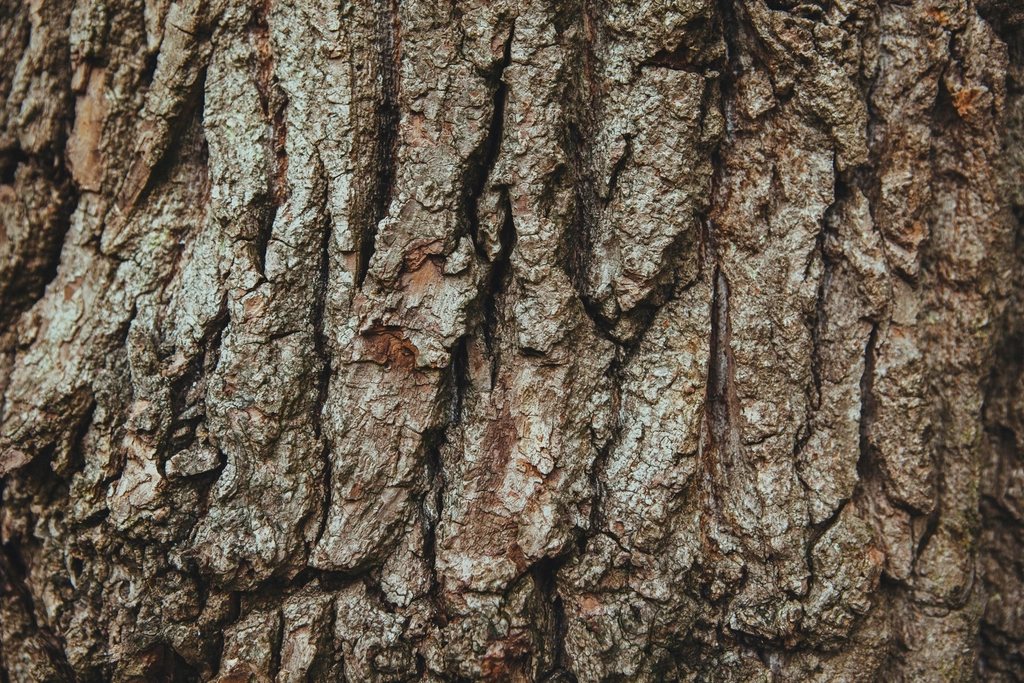
From November to April, bark carries the weight of identification. Five textures cover most cases. Smooth grey belongs to beech and young ash, rowan and holly. Peeling white or papery bark is birch. Fissured in long vertical ridges is oak, sweet chestnut and older pine. Flaking in irregular plates is sycamore and plane. Orange in the upper branches is the Scots pine and nothing else. Rubbing a hand over the trunk, where we can reach it, tells us as much as looking: beech feels cool and tight, oak coarse and corky, birch dry and papery.
Buds when there are no leaves
Buds are the other winter clue and they need no leaves at all. Black buds mean ash. Sticky brown buds the size of a fingertip mean horse chestnut. Long, slim, coppery buds mean beech. Clusters of small buds at the end of the twig mean oak. Round, slightly green buds on a twig that smells faintly of almond when scratched mean bird cherry, a bonus tree once the twelve are secure.
A method for the walk
We find it useful to pick one tree at a time and stay with it for a whole year. A single tree at the end of the street, met on the way to the shop, will show us its buds in February, its flowers in April or May, its full leaf in June, its fruit in September and its bare shape in December. By the second year we know it, and every other tree of that species becomes familiar on sight. The leaf in the hand is the beginning, but the tree in all its seasons is the thing we are actually learning.
For anyone whose walking is limited, a street of pollarded limes, a churchyard yew, the plane trees of a square or the ornamental cherries of a car park are all worth the same attention. Trees repay slow looking better than almost anything else outdoors, and they wait for us.