
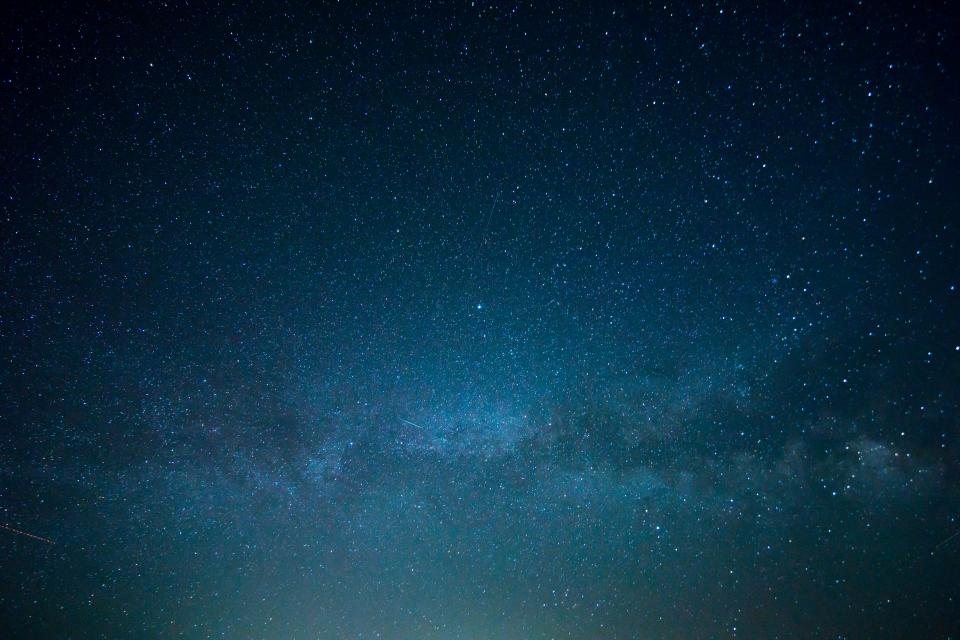
The sky keeps a calendar, and unlike most calendars it repeats with perfect reliability. The same meteor showers return in the same weeks every year, the Moon runs through its phases every twenty-nine and a half days, the planets drift into and out of the evening sky on schedules worked out centuries ago, and eclipses, rarer and stranger, can be predicted to the second. Knowing the shape of that year means we are never surprised by a good night, and never out in the cold for a poor one. Here is the sky’s calendar in general terms, for anyone with a garden or a balcony.
Meteor showers: what they are and how to watch
A meteor is a grain of dust, usually no bigger than a pea and often smaller, hitting the top of the atmosphere at tens of kilometres per second and burning up in a flash a hundred kilometres above our heads. Sporadic ones fall every night. A shower happens when the Earth passes through the trail of dust left behind by a comet, and for a few nights the count rises from a handful an hour to dozens.
Watching needs no telescope or binoculars; they only narrow the view. We need a dark spot, a reclining chair or a groundsheet, a blanket, a hot drink and thirty minutes for our eyes to adapt. Meteors appear to radiate from one point in the sky, called the radiant, but they can streak anywhere, so we look at the widest, darkest patch of sky we can find and let our gaze rest. The hours after midnight are always better, because then we are on the forward-facing side of the Earth as it moves along its orbit, sweeping up dust like a windscreen. A bright Moon washes out all but the strongest meteors, which is why a shower is superb one year and forgettable the next.
The showers through the year
The main annual showers, with rough peak dates and typical rates under a dark, moonless sky:
- Quadrantids, peaking around 3 to 4 January: strong, up to 100 an hour, but a peak that lasts only a few hours, and a cold vigil.
- Lyrids, around 22 April: modest, 15 to 20 an hour, the first shower of the milder nights.
- Eta Aquariids, early May: dust from the most famous of comets, best from the southern hemisphere, a pre-dawn shower in the north.
- Perseids, peaking around 12 to 13 August: the shower everyone knows, 60 to 100 an hour, warm nights and often long, bright trails.
- Orionids, around 21 October: 20 an hour, fast and faint, from the same comet as the May shower.
- Leonids, around 17 November: usually 10 to 15 an hour, but famous for rare storms every few decades.
- Geminids, peaking around 13 to 14 December: the richest of the year, 100 to 150 an hour at best, slow and colourful, and active from early evening.
Most showers are active for a week or two either side of the peak at lower rates, so a clear night three days early is still worth the blanket.
The Moon: the calendar we can see
The Moon is the easiest object in the sky and the one that governs everything else. New moon gives us dark skies for meteors and the Milky Way; full moon gives us bright landscapes for a night walk and washes out the stars. In between, the line between light and dark on the Moon’s face, the terminator, is where the craters and mountains throw long shadows, and even the naked eye can see the ragged edge of it a few days either side of half moon.
The harvest moon is the full moon nearest the September equinox; for several evenings in a row it rises only a little later each night, which once let farmers work by its light. When a full moon falls near the Moon’s closest approach to Earth it appears slightly larger and brighter, a real but modest difference, perhaps a tenth larger than the smallest full moon of the year.
Eclipses: two kinds, two rules
A lunar eclipse happens when the full Moon passes through the Earth’s shadow. It is slow, safe to watch with bare eyes for its whole two or three hours, visible from anywhere on the night side of the planet, and, at totality, the Moon turns a deep copper red as it is lit only by every sunrise and sunset on Earth at once. There are usually two or three a year somewhere, and a total one is visible from any given place every couple of years.
A solar eclipse happens at new moon, when the Moon passes in front of the Sun. Partial solar eclipses are visible from a given place every few years; a total eclipse, when the sky goes dark and the Sun’s pale corona appears, is visible along a narrow track perhaps 100 to 200 kilometres wide, and any one spot on Earth sees one only every few centuries on average. Totality lasts at most a little over seven minutes and usually two to four. The rule is absolute: outside those minutes of totality, we never look at the Sun with unprotected eyes, and never through anything that is not made for the purpose. Certified eclipse glasses, or a pinhole in a piece of card projecting the Sun’s image onto the ground, are the only safe ways, and sunglasses are not.
The quiet events
Between the headline nights, the sky offers smaller pleasures. Around the solstices in June and December the Sun rises and sets at its farthest points along the horizon; marking where it goes down from the same window through a year is a slow, satisfying project. From late May to early August at higher latitudes, electric-blue noctilucent clouds sometimes glow low in the north an hour after sunset, so high that they are still in sunlight. In early spring and again in early autumn, from a truly dark place, a faint pyramid called the zodiacal light stands up from the horizon after dusk or before dawn: sunlight scattered off dust in the plane of the solar system.
The planets keep appointments too. Every year or two Venus blazes in the evening sky for months, then swings past the Sun and reappears at dawn. Jupiter and Saturn come to opposition once a year, rising at sunset and shining all night. Now and then two planets pass within a finger’s width of each other, a conjunction, lovely to the naked eye and over in a few evenings.
Making the year a habit
None of this requires travel. A garden with the house lights off, a park bench with a view of the horizon, a lay-by on a hill above town: these are enough. What helps is a calendar with the peak nights circled, a blanket by the door, and a willingness to go out for twenty minutes without expecting anything. Some nights we will see one meteor and a lot of cloud. Some nights we will see the Moon go red, or a fireball that lights the garden, and remember it for life. The sky keeps its calendar. We only have to keep ours.