
Ten thousand steps comes to roughly five miles for most people, according to Women’s Health, though your stride can nudge that figure up or down. At an ordinary walking pace, expect to be out for somewhere between an hour and a quarter and an hour and forty minutes. The number matters less than the habit, and you can reach a good version of it without counting anything.
So how many miles is 10,000 steps?
The usual answer is about five miles. That is a working estimate rather than a fixed rule, because it depends on how long your steps are.
If you want a more personal figure, you can work it out in a few minutes. Pick a flat, quiet stretch of path that you can measure, such as a straight section of towpath or a park avenue with known length markers. Do it twice and average the results, since the first attempt often comes out a touch unnatural.
Once you have your stride length, you can turn any step count into distance. It also gives you a way to plan a loop before you leave the house: decide how far you want to go, and you have a rough idea of how many steps that will be.
- Choose a flat, straight stretch you can measure or that has distance markers.
- Walk it at your usual relaxed pace, counting every step.
- Divide the distance by your step count to get your average stride.
- Repeat once and average the two results.
How long does it take to walk 10,000 steps?
Time is where the numbers vary most, because pace changes everything. As one personal trainer quoted in Women’s Health explains, a moderate pace of about 3.0 mph works out to roughly 20 minutes per mile, so five miles takes around an hour and 40 minutes. Pick up the speed to about 4.0 mph, or roughly 15 minutes per mile, and the same distance takes around an hour and 15 minutes.
That is a long block of time if you imagine it as one walk, which is partly why the figure puts people off. The more realistic picture is that the steps accumulate across the whole day. Moving around the house, walking to a shop, doing the garden and taking a proper outing all count toward the total.
When you plan a dedicated outing, think in terms of a comfortable duration rather than a target count. A relaxed loop that suits your energy for the day will always serve you better than a forced march to hit a number.
Does the terrain change the count?
Yes, though the sources behind this article do not put precise figures on it, so treat this as general guidance. Surfaces that slow you down tend to shorten your stride. The result is that the same distance can take more steps, or the same number of steps can cover less ground, than on a smooth pavement.
This is useful to know if you walk mostly outdoors rather than on a treadmill. A step counter on a woodland path will often read differently from one on a flat canal towpath, even over the same time. Neither reading is wrong. They simply measure different kinds of effort.
For that reason, it makes sense to judge an outdoor walk by how long you were out and how it felt, not only by the figure on your wrist or phone. A slow loop of a local park, with stops to look at trees or birds, can be a perfectly good day’s walking even if the count looks modest.
Practical tips for uneven ground
- Expect your pace to drop on soft or loose surfaces, and let it.
- Allow extra time for hilly or muddy routes rather than rushing to keep up.
- Compare like with like: judge a towpath walk against other towpath walks.
Where did the 10,000-step figure come from?
It is not the product of clinical research. According to the trainer quoted in Women’s Health, the recommendation grew out of a Japanese company’s marketing campaign for a pedometer in the 1960s — a claim also documented by researchers including Catrine Tudor-Locke and others who have traced the figure’s origins in public health literature. The device’s name translated to something like “10,000 step meter,” and at the time there was no research showing that 10,000 steps was the gold standard. The target was set high to encourage a healthier population.
That origin does not make walking pointless. Walking is low-impact, easy to adjust through speed and effort, and open to anyone with lower-body mobility. It simply means the round number carries no special authority. It is a convenient goal, not a threshold your body recognises.
There is also research suggesting you do not need to reach it. Research reported by Women’s Health found that the sweet spot for lowering the risk of disease and premature death may sit below 10,000 steps a day, with benefits that may plateau beyond a certain point. If 10,000 feels out of reach, you are not missing a cliff edge.
How do you build up to it without overdoing it?
Start from where you are, not from where the number says you should be. If you currently manage something like 2,000 steps a day, jumping straight to 10,000 can be unrealistic and even unsafe, because your muscles and joints need time to adjust. Gradual progress is the sensible route.
One approach from the same trainer is to add 2,000 to 3,000 steps to your current daily figure, then hold there for a couple of weeks before adding more. You continue that way until you reach the 7,000 to 8,000 range or beyond, if that suits you. There is no deadline, and a slower build is more likely to turn into a lasting habit.
Breaking the day into short outings also helps. Walks of 15 to 20 minutes are easier to fit in and feel less daunting than one long session. A lap of the block, a walk with the dog, or parking a little further from the shops all add up.
If you want to spend that time outside rather than on pavements, a short loop from your own front door works well, and a quiet towpath or park path makes the minutes more pleasant. Walking at a pace that lets you hold a conversation, and noticing what is around you, keeps the whole thing relaxed and non-competitive.
- Check where you are now before choosing a target.
- Add a small amount at a time, and stay at each level for a while.
- Split the day into shorter walks if one long outing feels like too much.
- Treat the number as a guide, and stop to rest whenever you need to.
Related reading
- Gardening Is Outdoor Time: The Hours You Already Have
- Skyline Drive Trails: How to Pick a Walk Along the Ridge Road
Sources
- How Many Miles Is 10000 Steps? Here’s How Far You … (womenshealthmag.com, accessed 2026-11-04)
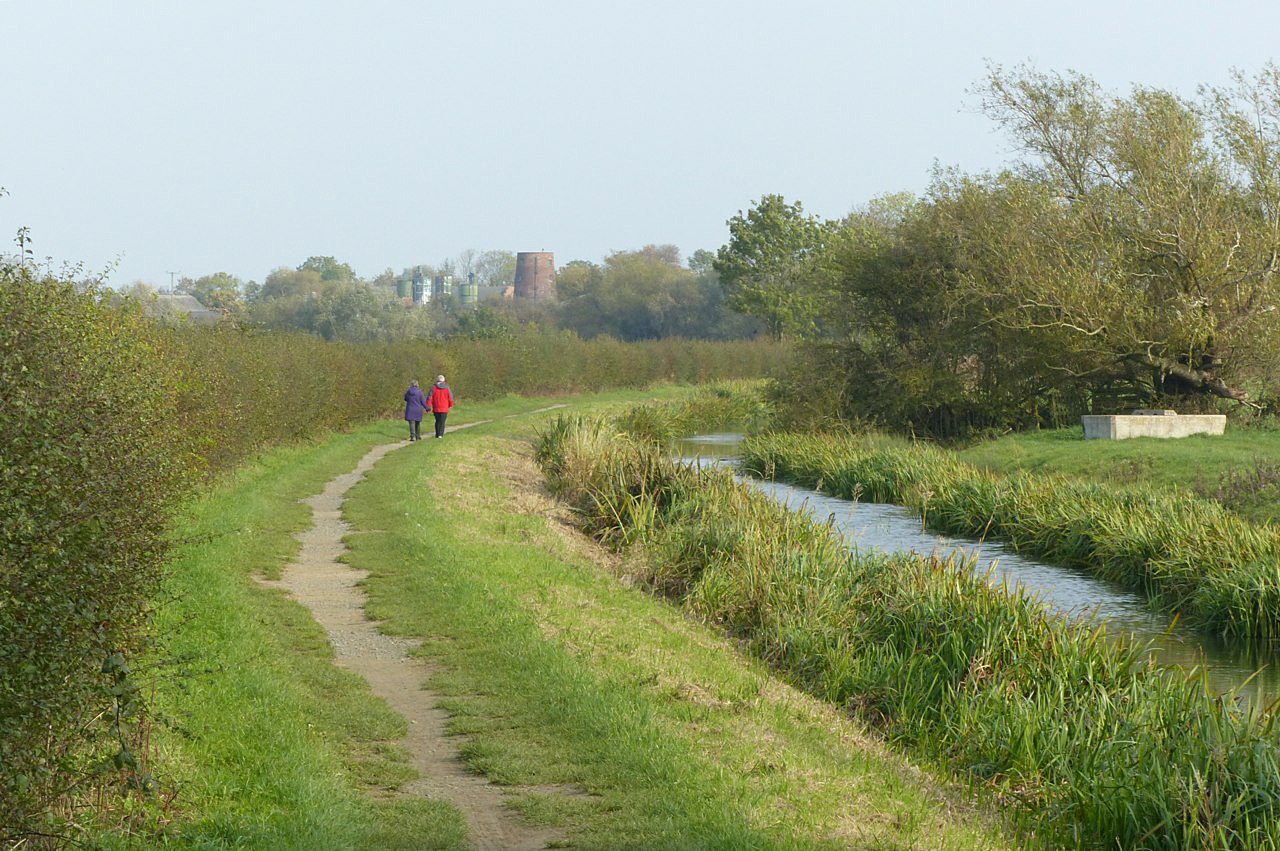
Photo: Walking the towpath – geograph.org.uk – 6644880, by Alan Murray-Rust, CC BY-SA 2.0 (Wikimedia Commons)