
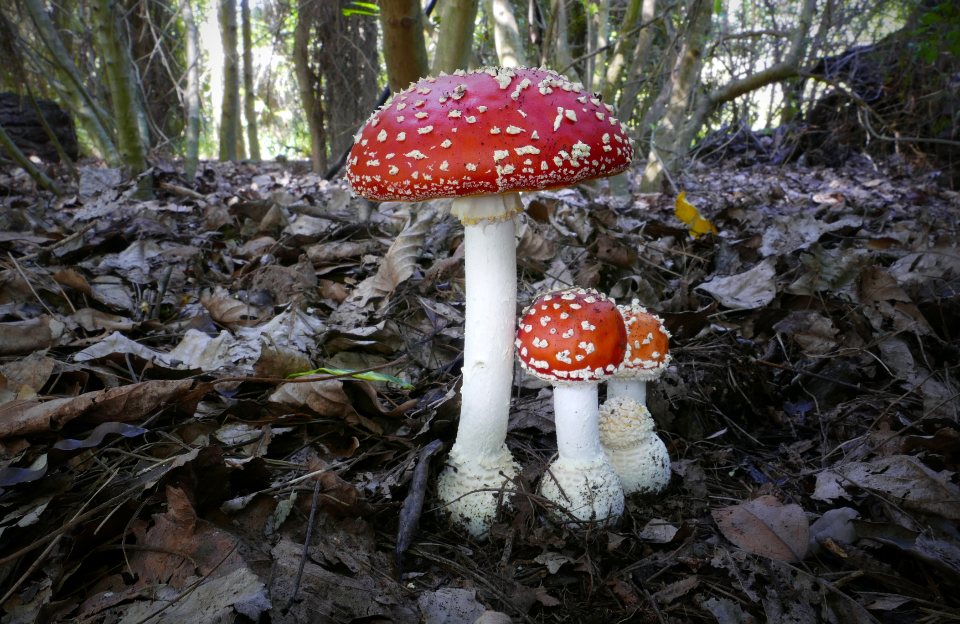
Autumn has a second flowering that most of us miss. From September through November, when the leaves are coming down and the birds have gone quiet, the woodland floor produces mushrooms in numbers and colours that would stop us in our tracks if they appeared in a flower bed. They are the fruiting bodies of fungi that live all year underground and inside wood, and for a few weeks they show themselves. A fungi walk asks for nothing but damp weather and a slow pace, and it works on a paved woodland trail, in a churchyard or on a lawn as well as in deep forest. Our one rule is simple and absolute: we look, we photograph, we do not eat.
When and where they appear
Fungi fruit when the ground is wet and the air is mild. The best walks fall two to five days after a good rain, while temperatures stay above about 5 degrees Celsius at night. A dry September produces almost nothing; a wet October can carpet a wood. The first hard frost thins the crop, though some species carry on into December, and a few bracket and jelly fungi are best seen in winter. Late morning after the dew has lifted gives the clearest light for looking and photographing.
Most fungi live in partnership with trees or on dead wood, so we look where trees are, and especially where old trees and fallen trunks have been left alone. Birch, beech, oak and pine each have their own companions. Grassland that has never been ploughed or fertilised, such as an old churchyard, a cliff-top or an ancient lawn, has a different set entirely, including the waxcaps that come in scarlet, orange and parrot green. Wood chip paths, compost heaps and the mulch around street trees produce their own regular visitors, so a park in the middle of a city is a perfectly good hunting ground.
A first sorting by shape
We do not try to name everything. Instead, we learn to sort what we see into a handful of groups by shape, which is the first step every identification takes and is a satisfying skill in itself.
- Caps with gills, the classic mushroom shape, with thin blades radiating under the cap. The largest and most varied group, and the one that contains most of the dangerous species.
- Caps with pores, the boletes, where the underside looks like a fine sponge. Often large and solid, growing from soil under trees.
- Brackets, shelves growing sideways from trunks and stumps, sometimes woody and lasting for years, sometimes soft and colourful.
- Puffballs and earthballs, round with no stem to speak of, releasing a puff of brown spores when pressed by rain.
- Jelly fungi, translucent, rubbery, orange, brown or black, on dead branches in wet weather.
- Cups, corals and clubs, the odd shapes: tiny scarlet cups on twigs in winter, branching coral-like tufts on the ground, yellow spindles in grass.
Within each group, we note where it grows, what it grows on, the colours of cap, gills and stem, whether the stem has a ring or a bag at the base, and any smell. Those six observations and a photograph from above, from the side and from underneath are enough to look something up later at the kitchen table.
Why we do not eat
The reason is not squeamishness. Several of the most poisonous fungi in the northern hemisphere look, to a beginner and sometimes to an expert, like species that are safely eaten. The death cap is a smooth greenish or pale mushroom with white gills that grows under oak and beech; it is responsible for the majority of fatal mushroom poisonings worldwide, and a single cap can be enough. The destroying angel is pure white and elegant. Both belong to a group whose members have a ring on the stem and a cup-like bag at the base, features that are easy to miss when a mushroom is pulled rather than dug, and easy to confuse with harmless lookalikes. Symptoms can take six to twenty-four hours to appear, by which time the damage to liver and kidneys is under way.
Eating wild fungi is a separate craft, learned over years with an experienced guide, and it is not what a nature walk is for. Treating every fungus as something to be looked at and left is the only rule that a beginner, a child or a group of mixed ages can be trusted to follow every time. It also means we are free to enjoy the most beautiful species, the fly agaric under the birches with its red cap and white flecks, the sulphur tuft glowing on a stump, without a moment’s thought about what they would do to us.
Walking lightly among them
Fungi are not damaged by being looked at, but they are damaged by being kicked, and a surprising number of people kick them. Each cap is a spore-releasing organ that took the underground network days to build, and a knocked-over mushroom releases nothing. We step around them, crouch or use a walking pole to lift a leaf, and if we want to see the gills we use a small mirror or a phone camera held low rather than picking. Where we do turn one over to photograph the underside, we set it back where it was. Many nature reserves and some public woods ask visitors not to collect fungi at all, and where picking is permitted it is normally limited to small amounts for personal use; the rules are posted at entrances or on the managing body’s notices, and following them is part of the walk.
Children take to fungi quickly, because the shapes are strange and the scale is theirs. The habit to teach early is hands behind the back, look with the eyes, and wash hands before eating anything at all, which is good practice in any case after a morning in the woods. Dogs are the other concern; a curious dog will eat what a child will not, and a lead in fungus season is kind to everyone.
A slow season’s reward
By the third or fourth walk, we start to see the wood differently. The same stump has a new bracket; the same birch has its ring of fly agaric back in the same place as last October. We learn that the beech trunk we sat against in June is being eaten from the inside by something that will one day fruit as a shelf the size of a dinner plate. There are more than ten thousand species of larger fungi in Europe alone, and we will never know most of them, which is exactly the point. The autumn walk is not a test we can pass; it is a floor we can spend the rest of our lives learning to read.