
Most of us begin birdwatching without meaning to. A bird lands on the fence while we are washing up, and we realise we do not know its name. That small itch is the whole hobby in miniature. We do not need a field trip, a long list or any equipment to start; we need ten birds we can name with confidence, seen from a window, a bench or a short walk from the door. Once those ten are secure, every other bird becomes a comparison with something we already know.
Why ten, and why these ten
Ten is a manageable number. It is enough to cover the shapes and habits that most other birds fall into, and few enough to learn in a fortnight of casual looking. The list below is built around the temperate towns and gardens where many of us live: species that are common, tolerant of people and active by day. Readers elsewhere will have their own equivalents, and the method works just the same. We learn size, shape, movement and voice before we worry about plumage detail, because feathers change with age and season while shape and behaviour stay put.
A useful trick is to fix three reference sizes in our minds. A house sparrow is about 15 centimetres from bill to tail. A blackbird is around 25 centimetres. A wood pigeon is roughly 40 centimetres. Almost every bird we meet at first can be described as sparrow-sized, blackbird-sized or pigeon-sized, and that alone narrows the field enormously.
The ten
- House sparrow. Sparrow-sized, chunky, with a thick seed-cracking bill. The male has a grey crown and a black bib; the female is streaked brown with a pale stripe behind the eye. They live in noisy groups and chirp rather than sing.
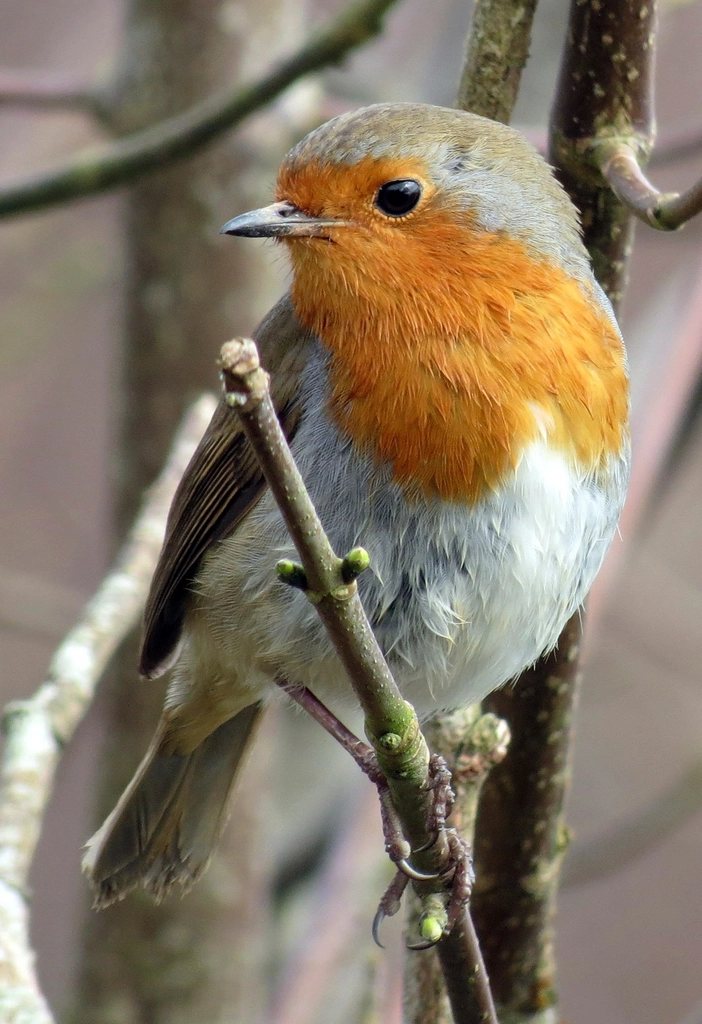
- Robin. Slightly smaller than a sparrow, round, upright, with an orange-red face and breast. It sings in almost every month of the year, a thin and wistful phrase, and often follows anyone turning soil.
- Blackbird. Blackbird-sized, naturally. The male is all black with a yellow bill and eye ring; the female is dark brown. Watch for the hop-stop-listen rhythm on a lawn and the tail flicked up on landing.
- Blue tit. Tiny, about 12 centimetres, with a blue cap, yellow breast and white cheeks. Acrobatic, often hanging upside down at the tips of twigs.
- Great tit. A larger tit with a glossy black head, white cheeks and a black stripe down a yellow belly. Its two-note song in late winter sounds like a squeaky wheel or a bicycle pump.
- Wood pigeon. Pigeon-sized and heavy, with a white neck patch and white wing bars in flight. It takes off with a loud clatter and sings a five-note coo that seems to stop mid-sentence.
- Magpie. Unmistakable black and white with a very long tail and a green-blue sheen in sunlight. It walks with a swagger and calls with a harsh rattle.
- Starling. Blackbird-sized but slimmer, with a short tail and a pointed bill. Dark plumage full of pale spots and oily green and purple gloss. Gregarious, quarrelsome and a superb mimic.
- Wren. One of our smallest birds at about 10 centimetres, brown, with a cocked tail. Rarely still, always low in cover, and possessed of a song far louder than its size suggests.
- Mallard. Our reference duck. The male has a bottle-green head and a white neck ring; the female is mottled brown with a blue wing patch. Almost every park pond has a few.
Looking before naming
When a bird appears, we resist reaching for a book for the first few seconds. Instead we ask a short set of questions in order. How big is it against our three reference sizes? What shape is the bill: thick or thin, straight or hooked? How does it move: hopping, walking, creeping along a trunk, hanging from a twig? Where is it: on the ground, in a hedge, high in a tree, on water? Only then do we note colours, and we try to note them in words rather than trusting memory. A pale eyebrow, a wing bar, a streaked breast. Five seconds of deliberate looking is worth five minutes of page turning.
Behaviour is often the giveaway. A robin holds itself upright and drops its wings. A blackbird runs a few steps and freezes. A wren scolds from inside a bush with its tail straight up. These habits do not change with the light, the season or the angle, which is why we lean on them first.
Listening as a second sense
Half of the birds we notice, we hear before we see. Learning ten songs alongside ten shapes doubles our reach at no cost. We start with the loud and the constant: the wren’s rattling burst, the great tit’s two-note see-saw, the wood pigeon’s coo, the magpie’s chatter. The robin’s song is the one to learn next, because it is sung by both sexes and through the winter, when almost everything else is quiet. We do not need to describe songs in musical terms. A private phrase, however silly, is enough to fix a song in memory, and the phrase that works for us is the right one.
Where and when to look
The best places for a beginner are ordinary. A window over a garden or a courtyard, a park with a pond and some old trees, a churchyard, a canal towpath, an allotment. Edges are richer than open spaces: where hedge meets lawn, where water meets bank, where woodland meets field. The first two hours after sunrise are the busiest, but late afternoon in winter is nearly as good, as birds feed hard before the long night. Rain quiets everything; the hour after rain is often lively.
If the walk to the park is difficult, none of this is lost. A feeder or a shallow dish of water within a few metres of a window brings the birds to us, and a chair by that window is as good a hide as any. Many of us watch best when we are sitting still anyway, and birds settle faster around a person who is not moving.
Keeping it gentle
We suggest a small notebook rather than an app at first. Writing “small brown bird, cocked tail, loud, in the ivy” is an act of attention that a tick box is not. A list of ten becomes fifteen, then thirty, without any effort beyond continuing to look. There is no test, no rate of progress that matters, and no wrong way to do it. The sparrow on the fence is the same sparrow whether we know its name or not; the difference is that once we do, we find we have been surrounded by company all along.