
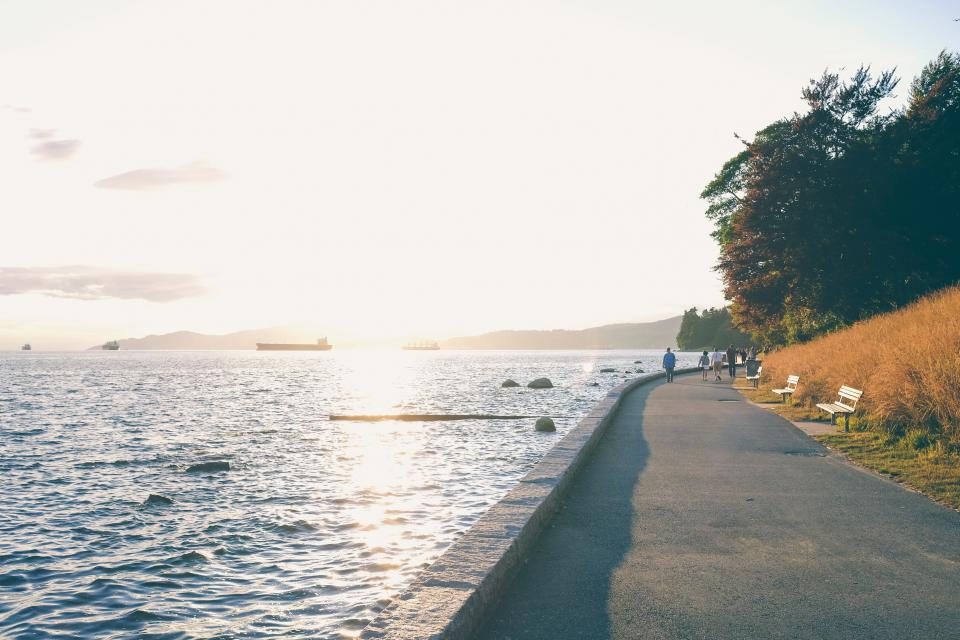
Most of us carry a picture of “a proper walk” that involves a car, a map and a whole free Saturday. It is a lovely picture, and it is also the reason so many of us walk far less than we would like. The twenty-minute rule is a way around that. It says that the walk which begins the moment you close your front door, lasts about twenty minutes, and brings you back the same way, counts. Not as a warm-up for something better. As the thing itself.
We have used it for years, in flats and terraces and one house at the end of a lane with no pavement at all, and it has changed how we think about where the outdoors starts. The short answer is: at the threshold.
Why twenty minutes
Twenty minutes is not a magic number, but it is a useful one. At an ordinary walking pace of around five kilometres an hour, twenty minutes takes you roughly one and a half kilometres from home. Turn around and you have walked three kilometres in forty minutes, which is close to four thousand steps for an adult of average height.
Public health guidance in most countries suggests about 150 minutes of moderate activity a week, and brisk walking qualifies. A single twenty-minute walk on each of the seven days adds up to 140 minutes, so the rule alone brings you within touching distance of the recommendation, with no equipment and no membership.
Twenty minutes is also short enough to be hard to refuse. It fits before breakfast, between two calls, or after the children are down. If you tell yourself you will walk for an hour, a wet forecast or a tired evening will cancel the plan. Twenty minutes survives most excuses.
Drawing your circle
The first useful exercise is to draw, roughly, the circle you can reach in twenty minutes on foot. On a paper map or a phone screen, that is a radius of about one and a half kilometres, less where hills or river crossings get in the way. Inside that circle is your everyday territory, and most people are surprised by how little of it they have seen.
We suggest walking every street, path and alley inside the circle over the course of a season. Take a different turn each day. Follow a footpath sign you have driven past a hundred times. Find where the stream goes after it disappears under the road. Within a month you will know which garden has the early crocuses, where the swifts scream in June, and which bench catches the last of the evening sun.
Circles are honest about what a place offers. A city circle might hold a canal towpath, two small parks, a churchyard full of old yews and a market square. A village circle might hold a lane, a field edge, a ford and a lot of sky. Neither is better. Both reward attention.
The same walk, every day
There is a case for variety, and there is a stronger case for repetition. Walking the same loop through the year is the cheapest natural history course available. You notice the hawthorn coming into leaf a week before the ash, the first swallow over the allotments, the morning the puddles have a skin of ice. A single route walked two hundred times tells you more than two hundred routes walked once.
Repetition also removes decisions, and decisions are what stop us going out. When the loop is fixed, the only choice left is the front door. Many of us find we take our first steps before we have properly decided to go, which is the point.
Making the door easier to open
The walk itself is the easy part. Leaving is the hard part, so it is worth designing for it. A few habits that have worked for us:
- Keep the shoes you will actually wear by the door, laced loosely, with a waterproof on the hook above them.
- Choose a fixed trigger: the kettle going on, the end of the school run, the last email of the day.
- Leave the phone in a pocket, or leave it at home. Twenty minutes is short enough that nothing will collapse.
- Walk in the rain at least once on purpose, so it stops being a reason not to.
- Let the walk be slow when you are tired. Pace is not the point; the door is.
People who walk with a pushchair or a wheelchair, or beside an older parent, will already know their circle is shaped by dropped kerbs, gradients and the width of gates. We think that is a reason to map it more carefully, not a reason to give up on it. A twenty-minute loop that works in every weather, with no steps and no stiles, is worth more than a beautiful route you can manage twice a year.
What you start to see
A regular short walk reorganises your senses. On the first week you notice traffic and litter. On the third you notice the wren singing from the hedge by the bus stop and the smell of cut grass on the verge. Later you notice that the ivy on the north wall is humming with bees in October, that a heron uses the drainage ditch behind the industrial estate, that the fox has a regular time and a regular route just as you do.
None of this requires leaving the town. Urban and suburban edges are surprisingly rich, partly because they are ignored. Railway cuttings, retention ponds, old cemeteries and the scruffy edges of playing fields hold more life than a tidy lawn ever will, and they are almost always inside the circle.
Keeping it going through the year
Winter is when the rule earns its keep. Short days mean the walk may happen in the dark, so a route with street lighting or a head torch helps, and a reflective band costs almost nothing. Cold air is not a hazard for most healthy adults; standing still in it is, so keep moving and keep the walk short.
Summer flips the problem. Early mornings are cooler, quieter and full of birdsong; late evenings bring bats over the rooftops. In the hottest weeks we walk in the shade side of the street and carry water even for twenty minutes.
The rule is not a target to beat. Some days it will stretch into an hour because the light is good. Some days it will be twelve minutes to the postbox and back in the drizzle. Both count, because both began at the front door, and that is the whole of the rule.
Read next: Outdoor Swing Bench: How to Choose One for Calm Time Outside